
How Can Imported Lamb Cost Less Than American Lamb?
Walk into almost any grocery store and you'll probably find imported lamb. In many cases, that lamb has traveled more than 6,000 miles from Australia or New Zealand, and somehow it can still cost less than lamb raised here in the United States.
How does that make sense?
It's a question we hear a lot, particularly as we've expanded our own California lamb program at Stemple Creek Ranch.
The answer gets into climate, land, processing, transportation, trade, and perhaps most importantly, scale.
And first, it's worth saying: Australia and New Zealand produce great lamb. Both countries have been raising sheep for generations and have built incredibly efficient industries around producing and exporting it.
This isn't a story about imported lamb being bad and American lamb being good. It's a story about two very different agricultural systems, and why we think there's an opportunity to build something stronger here at home.
How Did We Get Here?
The U.S. sheep industry is relatively small, and it has contracted significantly over the past several decades.
At the same time, imports have grown to fill much of the gap.
Today, imports account for roughly three quarters of the lamb and mutton supply in the United States. Australia supplies roughly 75% of those imports, with New Zealand accounting for another 24%.
But I think the long-term trend tells the story better than any single year's numbers. In 1970, the United States commercially produced roughly 540 million pounds of lamb and mutton while importing about 122 million pounds.
Today, that relationship has essentially flipped.
USDA's current 2026 forecast calls for just 129 million pounds of domestic production compared with 390 million pounds of imports.

What's interesting is that this isn't simply a story of imports replacing American lamb. The domestic sheep industry had already been shrinking for decades. As production declined, imports increasingly stepped in to supply a market that domestic producers weren't filling.
So why can lamb raised thousands of miles away still compete so effectively on price?
Scale matters.
Australia and New Zealand have large grazing industries built around sheep, with processing plants, distribution networks, ports, and export markets designed to move large volumes efficiently.
There are other advantages too. Exchange rates can make Australian and New Zealand lamb particularly competitive when the U.S. dollar is strong. New Zealand has a long grazing season and doesn't face the same large mammalian predator pressure that American sheep producers contend with.
Meanwhile, as the U.S. sheep industry has gotten smaller, we've lost much of the infrastructure around it. Fewer processors, longer transportation distances, and lower throughput all increase costs. A processing plant, refrigerated truck, or distribution network doesn't become dramatically cheaper because it handles fewer animals, the cost simply gets spread across fewer pounds.
But there's another loss behind those numbers that's harder to measure.
We've lost ranches, ranching families, and agricultural land along the way.
Keeping a family ranch intact from one generation to the next has never been easy. Today, land is expensive, agricultural margins are thin, succession is complicated, and productive farmland and rangeland face continued pressure from development and conversion to other uses.
When a ranch stops producing, we don't just lose the pounds of food it once supplied. We can lose generations of knowledge, a family's connection to the land, and another piece of the agricultural economy that supports a rural community.
And once that capacity disappears, it's incredibly difficult to rebuild.
That's part of what I see when I look at the decline in American lamb production. Behind that line on the graph are real ranches, real families, and rural communities that have changed along with it.
At the same time, even the 6,000-mile journey isn't as expensive as it sounds. Modern ocean freight is remarkably efficient when full containers move through an established global supply chain.
It's one of the interesting realities of our food system: Geographic distance doesn't always drive cost. Scale often matters more.
But efficiency isn't the only thing worth measuring. The decline of American lamb has also meant fewer sheep on American ranches, fewer families making a living from them, and fewer opportunities for the next generation to continue that work.
That's where this story becomes personal for me.
Lamb Has Always Been Part of Our Story
At Stemple Creek Ranch, raising lamb isn't new.
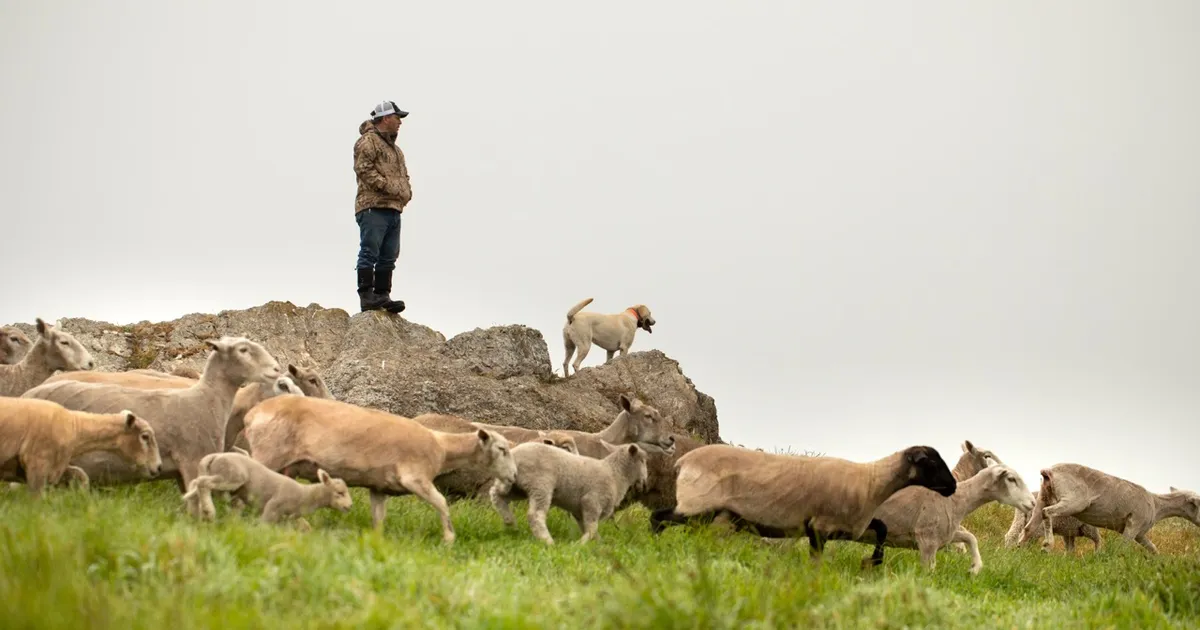
Sheep have been part of the story in Tomales for generations, and our own flock remains the foundation of our lamb program today. Our sheep spend their lives outside on pasture, raised on grass in the cool coastal climate of Northern California.
But my connection to sheep goes beyond Stemple Creek Ranch.
I grew up on my family's ranch in Humboldt County, where I'm the fifth generation of my family connected to the land. Sheep have always been part of that story as well.

At its peak in the 1950s, Humboldt County was home to more than 140,000 sheep. Our cool coastal climate, abundant grass, and hill country made this a natural place to raise them.
Ferndale Farms, my family's ranch, continues to raise sheep today on the same North Coast grasslands where I grew up, from the productive pastures of the Eel River Valley to the rugged hill country around Howe Creek Ranch.

It's something about seeing the sheep on those hills that just feels right to me.
Maybe it's because I've seen them there my entire life. Maybe it's because generations of my family saw the same thing before me.
But sheep are more than another livestock enterprise for our family. They're part of our landscape, our history, and the ranching culture of this region.
In a lot of ways, sheep are in our soul.
Interestingly, the primary breed at Ferndale Farms is the Perendale, a sheep developed in New Zealand to thrive on grass in hill country.
There's a certain irony in writing about imported New Zealand lamb while raising New Zealand genetics on my family's ranch. But I think that's also the point.
This isn't about rejecting what Australia or New Zealand have built. They've built incredibly successful sheep industries, and there is a lot we can learn from them.
The question is what we can build (or re-build) here.

Growing the Market for California Lamb
That's what excites me about where Stemple Creek's lamb program can go next.
We already raise most of our lamb on the home ranch in Tomales. Now we're growing the program by bringing in more lamb from Ferndale Farms, my family's ranch in Humboldt County.
It's a natural partnership between two ranches with long histories of raising livestock on Northern California's coastal grasslands.
But our vision is bigger.
Stemple Creek Ranch has spent years building relationships with families, chefs, grocery stores, farmers markets, and distributors throughout Northern California. We believe we can use that platform to build a larger and more reliable market for locally raised lamb.
If we can sell more California lamb, we can raise more sheep. More volume supports processors and distributors, gives chefs and retailers greater confidence in local supply, and eventually creates opportunities for more regional ranchers to participate.
And that investment reaches beyond the ranch.
Agriculture has always been part of the economic and cultural fabric of rural communities like the ones where I grew up. When we raise, process, and market more food within our region, we're supporting the processors, truck drivers, veterinarians, equipment suppliers, small businesses, and families that make those communities work.
We're not just trying to sell more local lamb. We're trying to create more economic opportunity in the rural communities that produce it.
That's how regional food systems actually get stronger, not because we talk about wanting one, but because we create the market that allows one to exist.

And we know the product can stand on its own.
Lamb sometimes gets a bad rap for being strong or "gamey." But not all lamb tastes the same.
Our seasonal California lamb is raised on grass in Northern California's cool coastal climate, producing a mild flavor and tender texture that we're really proud of. For people who think they don't like lamb, we think this is a pretty good place to try it again.
For me, there's something especially meaningful about connecting these two parts of my life.
I want to see Stemple Creek's lamb program continue to grow. I want Ferndale Farms to raise more sheep. And over time, I'd like us to create enough demand that more Northern California ranchers see an opportunity to participate.
Price Doesn't Tell the Whole Story
Australia and New Zealand have built remarkably efficient sheep industries. There's a lot to respect about that.
But when you're standing at the meat counter comparing American lamb with a less expensive imported option, you're looking at the products of two very different agricultural systems that tell two very different stories.
Both can produce great lamb.
For us, the opportunity is to take what Northern California already has - great grass, great ranches, great communities, and generations of knowledge - and connect it to a larger market.
The grass is still here. The ranches are still here. The families are still here. The stewardship is still here.
We're working to build the market that connects them.


